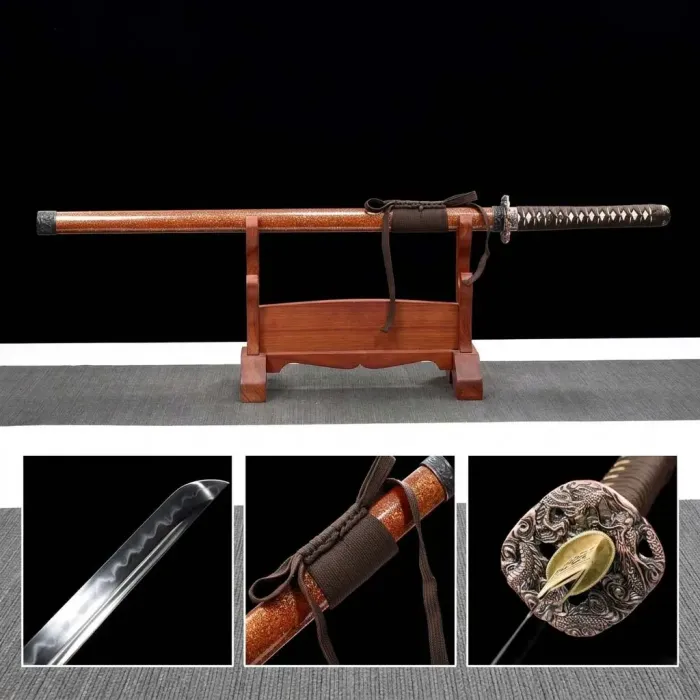
An heritage oriental sword stands a impressive display of technique, but how about you strive for to reveal your particular aesthetic? Altering your blade is a insightful journey, allowing you to create a truly uncommon piece. From the grip wrapping and fastening to the guard design and heat mark, each aspect offers a chance for personalization. This examination delves into the field of katana adjustments, providing facts for both newcomers and expert enthusiasts hoping to create their trace on the long-standing art of the samurai.
Novice's True Artistry
For starters eager to embark on the gratifying journey of Japanese swordsmanship , 1060 steel katanas provide an prime entry point. This defined grade of fundamental steel hits a optimal point between economical cost and performance . While not quite as hard as superior-grade steels, 1060 provides a adequate level of edge development , making it perfect for starters to cultivate the preliminaries of sword maintenance and experience the grace of genuine Japanese weaponry. It’s a superb choice for fostering experience without the economical burden of more premium steels.
T Gear Steel Cutlasses: Combining Performance and Affordability
For hobbyists seeking an authentic sword experience without exceeding the wallet , T10 metal katanas represent a attractive option. These tools offer a noticeable improvement in toughness compared to cheaper alternatives, exhibiting good edge retention and sufficient flexibility for rudimentary incising techniques. While not rivaling the top-notch characteristics of superior steels like T100 or folded substance , T10 provides a distinguished blend of utility and cost-effectiveness , making them a widespread choice for newcomers and those on a modest resources .
Overcoming the Cutting Surface : Modifying Your Sword's Attachments and Haft
Whereas the refined blade is undeniably the essential point of a katana, truly boosting its charm lies in the meticulous customization of its features and shaft . This art allows individuals to manifest their individual taste . Weigh the extensive possibilities: menuki - decorative adornments that supply visual detail ; the hamon enclosures – often intricately molded ; the tsuka essence itself, wrapped in genuine ito twine ; and the fusa stopper , which can be made from various matter like bullion or horn .
- Elect motifs that relate with you.
- Try with various components .
- Accent durability for a stable statement .
The Attraction of the Katana: Legacy, Artistry, and Steelwork
An historical weapon possesses a exclusive allure, steeped in phases of the nation's history and folklore . More than merely a weapon of conflict , it's a mark of the samurai ethos – a fusion of expertise and command . Its development spanned multiple generations, with early metallic weapons evolving into the slender curvature and efficient edge we perceive today. The production involved is truly extraordinary , requiring long periods of instruction to complete. The process involves a intricate folding of refined metal , creating layers that reinforce the blade's flexibility and slicing ability. Multiple schools of crafting appeared , each with their separate secrets and techniques for achieving the ultimate poise and precision - a truly grueling pursuit.
- Former Katana designs
- The role of the Japanese sword in bushi culture
- Classic crafting styles
Opting for the Optimal Steel for Your Oriental Blade Project: 1060 vs. T10
Determining the fitting steel is crucially important for any cutlery project, and the conclusion between 1060 and T10 can be intricate. 1060 is a well-known American element, offering a solid balance of firmness and endurance, supplying it comparatively easy to forge. However, T10, a Oriental steel, frequently boasts increased wear durability and can conceivably achieve a more peak hardness, although it can be somewhat difficult to apply and requires detailed heat forging. Consider your capability and targeted characteristics: for a newcomer, 1060 may be a more origin, while the competent smith might value the enhanced qualities of T10.
- Ease of Operating
- Erosion
- Conclusive Strength
Realizing the Capability: Sophisticated Katana Tuning Practices
Becoming proficient in blade modification extends far beyond basic whetting. Serious masters are now delving into advanced techniques to truly release a blade's hidden potential. This features intricate work with the temper line, utilizing specialized resources for differential heat treatment and carefully choosing the outline of the protector to optimize balance and performance. Beyond purely functional customizations, artisans are increasingly focused on producing unparalleled aesthetic splendor, through complex incising and layered finishes that truly transform a katana into a fine art.
Building a 1060 Sword from Basic Metal to Beauty
The journey commences with plain 1060 iron , a solid material far distant the fine katana it will evolve . Accomplished bladesmiths use a detailed process of combining and forming the crude steel, repeatedly burning it and hammering it to discard impurities and build a even grain structure. This tiring process, often lasting for katana sword periods , builds the fundamental resilience and suppleness characteristic of a standard Japanese weapon . Supplementary heat treatments , including controlled hardening and curing , are critical to achieve the specific symmetry of sharpness, stability and elegance .- Stacking: Diminishes impurities and creates grain structure.
- Molding: Molds the steel into the initial blade form.
- Curing: Directs the final hardness and flexibility.
The Ongoing Allure of the Katana: Detailed Survey of Metal and Enhancement
Every traditional katana stays a potent symbol embodying Japanese style , its draw far surpassing mere combat tools . Forged from unique steel and commonly featuring intricate decorations , the approach of creation itself is a venerated art. Beyond the central craftsmanship, the ability to refine a katana - from the patterning to the tsuka wrapping and habaki - enables for a genuinely individual embodiment for both admirers and operators alike. This amalgamation of tradition-rooted steelwork and boundless personalization brings the katana's continued presence across the realm .